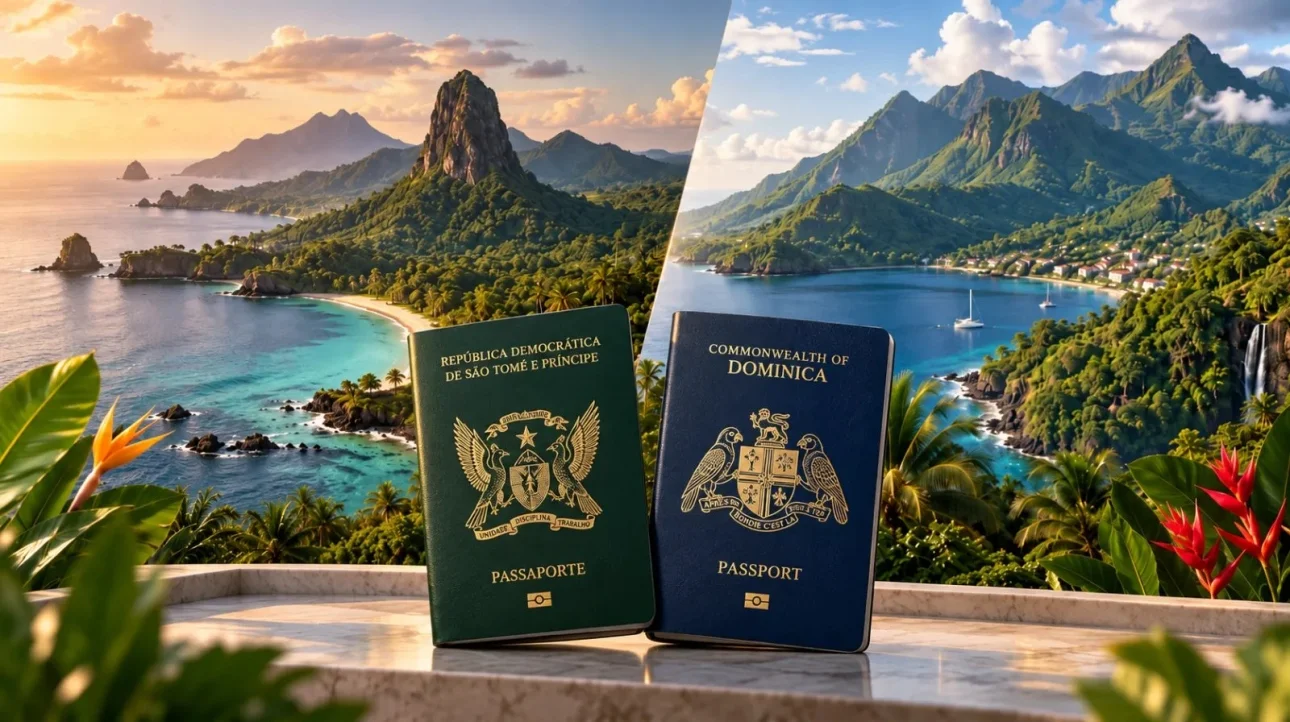
A proper Caribbean Citizenship by Investment Comparison 2026 should go far beyond asking which programme has the lowest headline contribution. The five established Caribbean programmes—Dominica, St Kitts and Nevis, Grenada, Antigua and Barbuda, and Saint Lucia—now operate with materially different family pricing, real estate thresholds, interview rules, processing benchmarks and post-citizenship obligations. For a single applicant, Dominica currently has the lowest contribution threshold at US$200,000. For a family, Grenada, Saint Lucia or Antigua may become more competitive depending on family size and dependant ages. Entrepreneurs with a future US E-2 strategy may focus on Grenada, while investors who want a capital-return structure may find Saint Lucia’s government bond route more relevant. The best Caribbean citizenship programme therefore depends on what you actually need the second citizenship to achieve.
Last updated: 11 October 2026. Fees, due diligence rules, processing times and programme requirements can change. Figures below should be reconfirmed before an application or investment is submitted.
Caribbean CBI Programs Compared at a Glance
| Programme | Lowest Contribution | Real Estate | Indicative Processing | Family Strength | Physical Presence | Standout Feature |
|---|---|---|---|---|---|---|
| Dominica | US$200,000 | From US$200,000 + government fee | Several months | Strong | No standard residence requirement | Lowest single-applicant contribution |
| St Kitts & Nevis | US$250,000 | From US$325,000 | 120–180 days | Strong | No mandatory residence under current SISC rules | Longest-established programme |
| Grenada | US$235,000 | From US$270,000 + US$50,000 government contribution in qualifying structure | Roughly 3–6 months | Very broad | No visit required | US E-2 treaty nationality |
| Antigua & Barbuda | US$230,000 | From US$300,000 | Around 3 months in straightforward cases | Excellent for larger families | 5 days in first 5 years | UWI Fund for families of 6+ |
| Saint Lucia | US$240,000 | From US$300,000 | Around 90 days guideline | Strong | No current general residence requirement | Government bond option |
Official programme rules confirm the current contribution thresholds of US$200,000 in Dominica, US$250,000 in St Kitts and Nevis, US$235,000 in Grenada, US$230,000 in Antigua and Barbuda and US$240,000 in Saint Lucia.
The cheapest headline figure is only one part of the comparison. Due diligence, processing, interview, passport and family charges can materially change the final cost.
Which Caribbean Countries Offer Citizenship by Investment in 2026?
There are five established sovereign Caribbean states currently operating direct citizenship by investment programs:
- Dominica
- St Kitts and Nevis
- Grenada
- Antigua and Barbuda
- Saint Lucia
These are direct citizenship programmes. They should not be confused with residence-by-investment schemes where an investor first receives a residence permit and may only become eligible for citizenship years later.
The programmes also have different levels of maturity.
St Kitts and Nevis dates to 1984 and remains the longest-established programme of its type. Dominica has operated since 1993. Antigua and Barbuda and Grenada introduced their current frameworks in 2013, while Saint Lucia’s programme was established under legislation enacted in 2015.
Minimum Investment and Total Cost Comparison
The contribution amount is not the true total application cost.
Applicants should separate:
- Qualifying investment
- Processing charges
- Due diligence
- Interview costs
- Citizenship or registration certificates
- Passport charges
- Authorised agent and document costs
For a single applicant using the lowest contribution route, the current government-level starting costs look approximately as follows.
| Programme | Contribution | Main Additional Published Fees | Indicative Starting Government Cost* |
|---|---|---|---|
| Dominica | US$200,000 | US$7,500 DD + US$1,000 processing + US$1,000 interview + US$500 certificate | ~US$210,000 |
| Grenada | US$235,000 | US$1,500 application + US$5,000 DD + US$1,500 processing + US$1,000 interview | ~US$244,000 |
| Antigua & Barbuda | US$230,000 | US$10,000 processing + US$8,500 DD + US$300 passport | ~US$248,800 |
| Saint Lucia | US$240,000 | US$2,000 processing + US$8,000 DD | ~US$250,000 + interview/verification cost |
| St Kitts & Nevis | US$250,000 | US$10,000 DD + US$250 application processing | ~US$260,250 |
*These are planning figures, not quotations. They exclude professional fees, banking, legalisation, translation and any enhanced due diligence.
Dominica’s current EDF schedule lists a US$200,000 contribution, US$7,500 main-applicant due diligence, US$1,000 processing, US$1,000 interview and US$500 naturalisation certificate.
Grenada’s current programme table lists a US$235,000 NTF contribution plus application, due diligence, processing and interview charges.
Antigua’s NDF currently requires US$230,000, with US$10,000 processing for a single applicant and US$8,500 main-applicant due diligence.
Saint Lucia’s NEF requires US$240,000 for the applicant and up to three qualifying dependants, plus US$2,000 processing for the main applicant and US$8,000 due diligence.
St Kitts and Nevis currently requires US$250,000 under SISC for a main applicant or family of up to four, with US$10,000 main-applicant due diligence.
Donation, Real Estate and Government Bond Options
The five programmes do not offer identical investment structures.
Contribution Routes
Every programme provides a non-refundable contribution option.
- Dominica: Economic Diversification Fund from US$200,000
- St Kitts and Nevis: SISC from US$250,000
- Grenada: National Transformation Fund from US$235,000
- Antigua and Barbuda: NDF from US$230,000
- Saint Lucia: National Economic Fund from US$240,000
A contribution is usually the simplest route. It does not create an asset and there is nothing to resell later.
Real Estate Routes
All five also provide property-related routes, but thresholds and holding periods differ.
Dominica requires at least US$200,000 in an approved project. The property normally has to be held for three years, or five years if it is later resold to another CBI applicant.
St Kitts and Nevis starts at US$325,000 for qualifying approved developer or condominium interests and requires a seven-year holding period. Approved single-family private homes start at US$600,000.
Grenada permits approved-project investment from US$270,000 under qualifying shared structures, together with a US$50,000 government contribution. Other approved project structures can require a higher property amount.
Antigua and Barbuda requires at least US$300,000 in approved real estate, generally held for five years.
Saint Lucia currently lists approved real estate from US$300,000 plus administration fees.
Government Bonds
Saint Lucia is the only one of the five currently offering a clearly defined government bond pathway.
Its National Action Government Bond requires:
- US$300,000 investment
- US$50,000 non-refundable administration fee
- Five-year holding period
- No interest
The principal is held as a government bond rather than permanently contributed.
This makes Saint Lucia particularly relevant to investors who prefer a capital-return structure over an outright donation.
Processing Time, Due Diligence and Interview Requirements
Processing time is one of the most misunderstood comparison points.
No Caribbean programme can guarantee approval within a fixed number of days. Due diligence can extend any application.
| Programme | Current Published Benchmark | Interview Position |
|---|---|---|
| Dominica | Several months; guidance often centres on roughly 3 months to approval in principle | Mandatory for applicants 16+ |
| St Kitts & Nevis | 120–180 days | Main applicant mandatory; dependants 16+ may be required |
| Grenada | Official materials range from 60 business days to a broader 3–6 months | Online interview required |
| Antigua & Barbuda | Regulations provide for decision/denial/delay notification within around 3 months | May be requested |
| Saint Lucia | Approximately 90 days guideline | Main applicant interview/identity verification |
Dominica requires mandatory interviews for applicants aged 16 and above as part of its enhanced due diligence framework.
St Kitts and Nevis publishes a 120–180-day decision window after acknowledgement and requires the main applicant to attend an interview.
Grenada’s current FAQ mentions approval within 60 business days subject to satisfactory checks, while the agency’s own overview uses a broader three-to-six-month expectation. Planning around the more conservative range is safer.
Antigua’s legislation requires the Unit to notify the agent within three months whether the application is approved, denied or delayed for cause.
Saint Lucia’s official FAQ uses an approximate 90-day processing guideline.
Family Eligibility and Dependant Rules
Family composition can change which programme is cheapest.
Dominica
Dominica permits a spouse and qualifying dependent children, parents and grandparents. Adult dependants must satisfy the programme’s dependency rules.
St Kitts and Nevis
The programme supports spouses, dependent children and qualifying parents. SISC is particularly notable because US$250,000 currently covers a main applicant or family of up to four before due diligence and processing.
Grenada
Grenada has one of the broader family definitions. The programme can include a spouse, children, parents, grandparents and qualifying siblings.
Antigua and Barbuda
Antigua is especially flexible for larger families. It permits financially dependent children up to age 30, dependent parents and grandparents aged 55+, and qualifying unmarried siblings.
Its UWI Fund is specifically designed for families of six or more and currently requires US$260,000 inclusive of processing fees for the initial six-person application.
Saint Lucia
Current rules allow a spouse, children generally up to 21 or up to 30 where fully supported, qualifying parents over 55 and certain minor siblings.
For families of up to four, the US$240,000 NEF contribution can make Saint Lucia highly competitive.
Residency, Visit and Passport Renewal Requirements
One of the advantages of Caribbean CBI is that most programmes do not require long-term relocation.
Dominica currently imposes no general residence or visitation requirement before or after citizenship. Adult passports are generally valid for 10 years, while children under 16 receive five-year passports.
St Kitts and Nevis states that SISC has no mandatory travel or residency requirement. Current programme guidance also refers to ordinary passport renewal rather than annual citizenship maintenance.
Grenada states that applicants do not need to visit before, during or after the application process. Grenadian passports are currently valid for five years.
Antigua and Barbuda is the main exception. CBI citizens must spend at least five days in the country during the first five calendar years after citizenship. Failure to satisfy the requirement can expose citizenship to deprivation under the programme rules.
Saint Lucia currently has no general physical-residence requirement for CBI citizens.
Dominica Citizenship by Investment
Dominica citizenship by investment remains the lowest-entry contribution option among the five established Caribbean programmes.
Its main strengths are:
- US$200,000 EDF minimum
- Approved real estate from US$200,000
- No physical residence requirement
- Long programme history since 1993
- Relatively simple two-route structure
Its main trade-off is family pricing. The EDF rises to US$250,000 for the main applicant plus up to three dependants, so a family should not assume Dominica remains the cheapest simply because it is cheapest for one person.
St Kitts and Nevis Citizenship by Investment
St Kitts and Nevis citizenship by investment is the most established option in the region.
It currently offers:
- SISC from US$250,000
- Public Benefit Option from US$250,000
- Approved real estate from US$325,000
- Private homes from US$600,000
- No mandatory residence under the SISC structure
The programme is usually more expensive for a single applicant than Dominica or Grenada, but the US$250,000 SISC covers a family of up to four before additional programme charges.
Grenada Citizenship by Investment
Grenada citizenship by investment stands out because Grenada is an E-2 treaty country with the United States.
The programme currently offers:
- NTF contribution from US$235,000
- Approved real estate
- Broad family eligibility
- No required visit
- Online due diligence interview
Grenadian nationality can create eligibility to pursue the US E-2 route, but it does not guarantee an E-2 visa. The US business must independently satisfy treaty-investor requirements.
Antigua and Barbuda Citizenship by Investment
Antigua and Barbuda citizenship by investment is especially competitive for larger families.
Its current routes include:
- NDF from US$230,000
- Real estate from US$300,000
- UWI Fund from US$260,000 for six-person families
- Approved business investment
The UWI route can be particularly attractive for a family of six or more because the first six applicants are covered by the US$260,000 amount including processing.
The key difference from the other programmes is the five-day physical-presence requirement during the first five years.
Saint Lucia Citizenship by Investment
Saint Lucia citizenship by investment offers the broadest range of financial structures among the five.
Its current options include:
- NEF from US$240,000
- Real estate from US$300,000
- National Action Bonds at US$300,000
- Approved enterprise and infrastructure routes
The bond route is its main differentiator. The US$300,000 principal is non-interest-bearing and must remain invested for five years, while a US$50,000 non-refundable administration fee also applies.
Best Caribbean CBI Program by Applicant Profile
There is no universally best Caribbean citizenship by investment programme. The answer changes with the applicant profile.
Best Option for a Single Applicant
For a cost-focused single applicant, Dominica is currently the strongest starting point.
Its US$200,000 EDF contribution is the lowest among the five, and the indicative government-level total remains below competing contribution routes.
Dominica therefore deserves first consideration when the primary goal is straightforward citizenship at the lowest established Caribbean entry cost.
Best Option for Families
There are two different answers.
For families of up to four, Grenada and Saint Lucia can be highly competitive because their core contributions cover multiple family members.
For large families, especially six or more, Antigua’s UWI Fund can become more attractive because its structure was specifically designed around larger applications.
Family age matters. Adult dependants increase due diligence and sometimes contribution costs, so the cheapest programme cannot be determined from family size alone.
Best Option for Entrepreneurs Seeking US E-2 Eligibility
Grenada is the clear programme to examine.
Grenada is an E-2 treaty country, which can make Grenadian nationality strategically useful for entrepreneurs who otherwise lack treaty nationality.
However, E-2 is a separate US immigration process. Citizenship does not equal visa approval. The applicant still needs a real US business, substantial capital investment and compliance with current US E-2 rules.
Best Option for a Refundable Investment Route
Saint Lucia’s National Action Government Bond is the clearest capital-return option.
The applicant invests US$300,000 in a non-interest-bearing government bond and holds it for five years. A US$50,000 administration fee remains non-refundable.
This option suits applicants who are comfortable locking capital rather than permanently donating the full qualifying amount.
Real estate routes across the five programmes also create potentially resaleable assets, but resale values are not guaranteed.
Fastest Caribbean Citizenship Option
There is no guaranteed single fastest Caribbean citizenship programme.
Saint Lucia publishes an approximately 90-day guideline. Antigua’s legislation also provides for an approval, denial or delay notification within about three months. Grenada’s current FAQ refers to 60 business days in satisfactory cases, although its broader agency guidance uses three to six months.
For practical planning, applicants should prioritise file quality and due diligence profile over advertised speed.
A weakly prepared “fast” application can easily become slower than a well-prepared application in another jurisdiction.
How to Choose the Right Caribbean Citizenship Program
Before choosing a programme, compare your priorities in this order:
- Eligibility: nationality restrictions, criminal history, previous visa refusals and source of wealth.
- Family structure: spouse, children, parents, grandparents and siblings.
- True total cost: not just the qualifying investment.
- Investment preference: donation, property or recoverable bond.
- Timeline: including document preparation and due diligence.
- Physical-presence obligations: particularly Antigua.
- Future strategy: mobility, business, US E-2 planning or family legacy.
For a single applicant who mainly wants a lower acquisition cost, Dominica may make sense. For a family of six, Antigua may rank differently. For an entrepreneur planning a US business strategy, Grenada may become the obvious shortlist. For an applicant who dislikes non-refundable contributions, Saint Lucia’s bonds or an approved property route may be more suitable.
The right comparison should therefore be based on your own family and financial profile, not on a generic “best passport” ranking.
For programme-specific details, review the dedicated pages for Dominica citizenship by investment, St Kitts and Nevis citizenship by investment, Grenada citizenship by investment, Antigua and Barbuda citizenship by investment and Saint Lucia citizenship by investment before making a final decision.
Frequently Asked Questions
What is the cheapest Caribbean citizenship by investment in 2026?
For a single applicant using a contribution route, Dominica currently has the lowest minimum contribution at US$200,000. Once due diligence and other government charges are added, the indicative government-level starting cost is around US$210,000 before professional and ancillary costs.
Which Caribbean countries offer citizenship by investment?
The five established Caribbean countries operating direct CBI programmes are Dominica, St Kitts and Nevis, Grenada, Antigua and Barbuda and Saint Lucia.
Which Caribbean CBI programme is best for families?
It depends on family size and ages. Grenada and Saint Lucia are competitive for families of up to four, while Antigua’s UWI Fund can be particularly attractive for families of six or more.
What is the fastest Caribbean citizenship by investment processing time in 2026?
Published benchmarks range from roughly three months in some programmes to four to six months in others. Saint Lucia uses an approximately 90-day guideline, while St Kitts and Nevis currently publishes 120–180 days. No programme guarantees approval within a fixed period.
Which Caribbean citizenship is best for a US E-2 visa strategy?
Grenada is the most relevant because it is an E-2 treaty country with the United States. Grenadian citizenship creates treaty-nationality eligibility, but E-2 approval still depends on satisfying separate US investment and business requirements.
Which Caribbean CBI programme offers government bonds?
Saint Lucia offers National Action Government Bonds. The current qualifying amount is US$300,000 plus a US$50,000 non-refundable administration fee, with a five-year holding period.
Which programme has the lowest real estate threshold?
Dominica currently starts at US$200,000 in approved real estate, although additional government and application fees apply.
Do Caribbean CBI applicants have to live in the country?
Most do not. Dominica, St Kitts and Nevis, Grenada and Saint Lucia do not currently impose a normal long-term residence requirement. Antigua and Barbuda requires CBI citizens to spend at least five days in the country during the first five years after citizenship.
Are Caribbean citizenship investments refundable?
Donation or fund contributions are not refundable. Approved property may potentially be resold after the programme’s holding period, subject to market conditions. Saint Lucia’s National Action Bond is designed to return the bond principal after the required five-year holding period, subject to the applicable bond terms.
How should I choose between the five Caribbean citizenship by investment programs?
Start with eligibility and family structure, then compare true total cost, due diligence, investment type, processing time, physical-presence requirements and your longer-term objective. The programme with the lowest headline contribution is not necessarily the best programme for your situation.