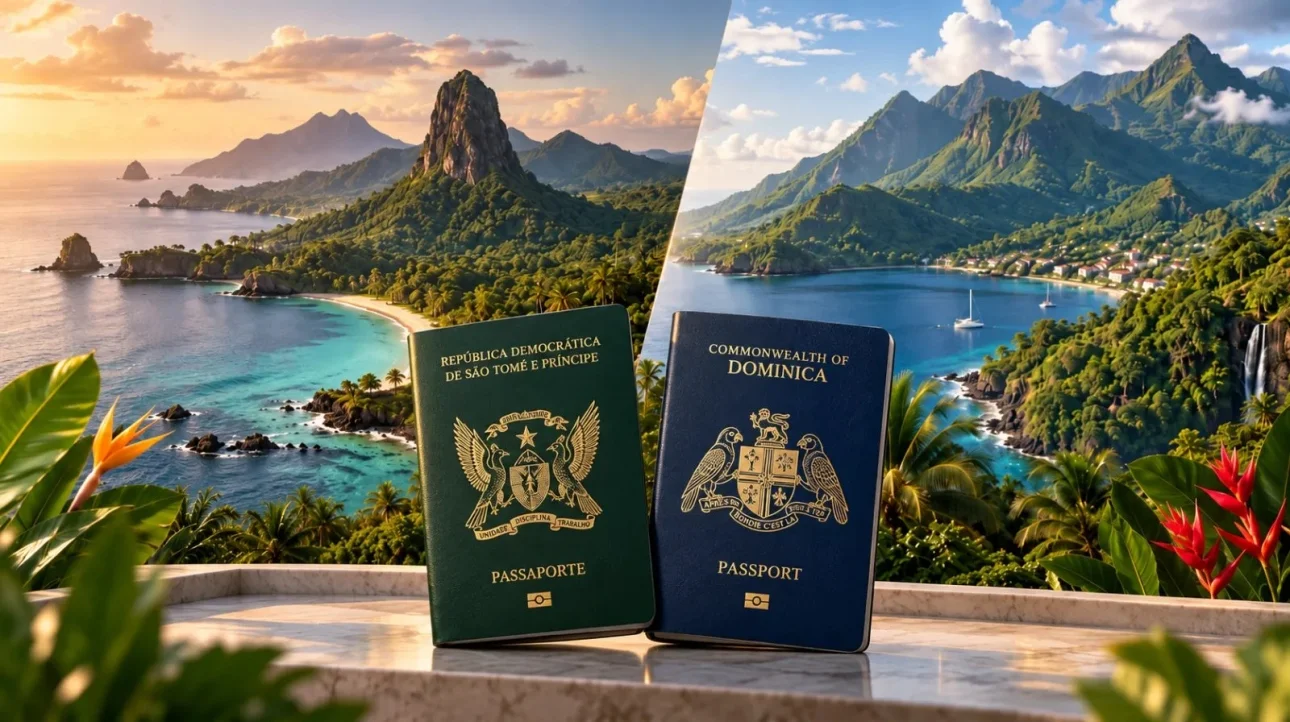
For investors comparing São Tomé and Príncipe citizenship by investment vs Dominica, the choice is not simply between a cheaper and a more expensive passport. São Tomé and Príncipe entered the citizenship-by-investment market in 2025 with a contribution starting at US$90,000, making it substantially cheaper than Dominica’s US$200,000 minimum. Dominica, however, has operated its programme since 1993, has a longer regulatory track record and currently offers significantly broader passport mobility. There are also important 2026 operational issues to consider in São Tomé, including temporary complications affecting the final naturalisation and passport issuance of some adult dependants. The right programme therefore depends on whether your priority is minimum capital, established programme history, family structure, processing certainty or international travel access.
Last updated: 28 September 2026. Fees, dependant rules, visa access and operational procedures can change. Applicants should obtain a current written quotation and eligibility assessment before transferring funds.
Key Takeaways
- São Tomé currently has one of the lowest contribution thresholds among active direct-citizenship programmes: US$90,000 for a single applicant.
- Dominica requires US$200,000 for a single EDF applicant or US$250,000 for a main applicant with up to three dependants.
- São Tomé launched only in 2025; Dominica has operated since 1993.
- Dominica currently provides materially stronger international travel access.
- Neither programme requires applicants to establish ordinary residence before or after citizenship under current published rules.
- São Tomé’s 2026 family rules are still evolving. Naturalisation and passport issuance for certain adult dependants are temporarily affected while legislative revisions are pending.
- The cheapest programme is not automatically the lowest-risk or most useful programme.
Quick Comparison for Investors
The clearest difference is cost. The more important differences appear when you add programme maturity, family rules, mobility and execution risk.
| Factor | São Tomé & Príncipe | Dominica |
|---|---|---|
| Programme launched | 2025 | 1993 |
| Main route compared | National Transformation Fund contribution | Economic Diversification Fund contribution |
| Single contribution | US$90,000 | US$200,000 |
| Family of 2–4 contribution | US$95,000 | US$250,000 for main applicant + up to 3 dependants |
| Each additional dependant | US$5,000 | US$25,000 under 18 / US$40,000 aged 18+ |
| Separate submission/processing | At least US$5,000 published; verify complete schedule | US$1,000 per application |
| Main applicant due diligence | Included/structured within programme fees in published materials | US$7,500 |
| Mandatory interview | No standard interview currently described | Yes, age 16+ |
| Residence requirement | None currently published | None |
| Published processing | Around 2–3 months, but post-approval issuance may take longer | Commonly around 3–6 months |
| Passport mobility | 60+ destinations without a prior visa under Henley-based data | 145 destinations in current Henley ranking |
| Schengen short-stay visa exemption | No | Yes |
| UK visitor visa required | Yes | Yes |
| Programme maturity | Very new | More than 30 years |
| Main risk profile | New programme and evolving implementation | Higher cost but mature operating framework |
São Tomé’s CBI programme was created under Nationality Law No. 07/2022 and Decree-Law No. 07/2025 and began operating in 2025. The IMF has since confirmed that the government launched the programme and incorporated expected CBI proceeds into its fiscal framework. Dominica’s programme dates to 1993 and currently operates under its Citizenship Act and the 2024 CBI Regulations.
For a cost-focused applicant, São Tomé starts far ahead. For someone prioritising a longer regulatory history and travel utility, Dominica presents a different proposition.
Minimum and All-In Cost for a Single Applicant
The primary keyword sao tome citizenship cost vs dominica produces a dramatic headline comparison:
São Tomé: US$90,000
versus
Dominica: US$200,000
Those are contribution amounts, not complete case costs.
São Tomé Single Applicant
Current programme materials publish:
- National Transformation Fund contribution: US$90,000
- Submission fee: US$5,000 per application
- Passport: US$350
- National ID: US$150
- Citizenship certificate: US$250
Using those clearly published components gives:
US$95,750 in visible government programme costs before professional and ancillary fees.
There is, however, a fee-verification issue worth highlighting.
Another government-authorised marketing agent currently publishes a separate US$5,000 processing charge in addition to the US$5,000 submission fee. Under that schedule, the same single-applicant government subtotal would be approximately US$100,750 rather than US$95,750.
That discrepancy is exactly why applicants should obtain a written government-fee breakdown before signing.
The comparison below therefore uses a range rather than pretending the available public schedules are perfectly aligned.
Dominica Single Applicant
For the EDF route, current official charges are:
- EDF contribution: US$200,000
- Processing: US$1,000
- Main applicant due diligence: US$7,500
- Mandatory interview: US$1,000
- Certificate of Naturalisation: US$500
Indicative official subtotal:
US$210,000
before Authorised Agent fees, document costs, banking charges or any enhanced due diligence.
Single-Applicant Comparison
| Cost | São Tomé | Dominica |
|---|---|---|
| Contribution | US$90,000 | US$200,000 |
| Published application/submission costs | US$5,000–10,000* | US$1,000 |
| Main due diligence | Included within published STP fee structure / confirm | US$7,500 |
| Interview | No standard interview published | US$1,000 |
| Citizenship documents | US$750 | US$500 naturalisation certificate |
| Indicative government subtotal | US$95,750–100,750* | US$210,000 |
*The range reflects conflicting currently published schedules from programme-authorised sources. Confirm the applicable CIU invoice before proceeding.
Purely on acquisition cost, São Tomé is roughly US$109,000–114,000 lower for a single applicant.
That is a major difference. It does not answer whether it delivers equivalent mobility, programme maturity or long-term predictability.
Cost for Families and Additional Dependents
Family pricing makes São Tomé even more aggressive.
Its current contribution structure is:
- Single applicant: US$90,000
- Family of two to four: US$95,000
- Each additional qualifying dependant: US$5,000
Dominica’s EDF pricing is:
- Main applicant: US$200,000
- Main applicant + up to three dependants: US$250,000
- Additional dependant under 18: US$25,000
- Additional dependant aged 18+: US$40,000
Family of Four Example
Assume:
- Main applicant
- Spouse
- Two children under 16
São Tomé
- Contribution: US$95,000
- Submission: US$5,000
- Four citizenship-document sets: 4 × US$750 = US$3,000
Visible published subtotal:
US$103,000
If the separate US$5,000 processing fee shown in another authorised schedule applies, that becomes approximately US$108,000.
Dominica
- EDF: US$250,000
- Processing: US$1,000
- Main applicant DD: US$7,500
- Spouse DD: US$4,000
- Four naturalisation certificates: US$2,000
- Interviews for adults aged 16+: approximately US$2,000
Indicative subtotal:
US$266,500
before agent and ancillary fees.
That creates a very large pricing gap.
But Family Eligibility Is Currently a Key São Tomé Risk
Published São Tomé programme criteria generally include:
- Spouse or qualifying partner
- Financially dependent children up to age 30
- Parents or grandparents aged 55+ who meet dependency requirements
However, a fresh update published on 21 September 2026 states that provisions affecting adult children aged 18–30 and parents/grandparents aged 55+ are currently being revised.
Applications involving these dependants may still be submitted and processed, but the adult family member’s final naturalisation and passport issuance can be suspended until the revised legislation takes effect.
This is highly relevant.
A couple with two young children and a family including two dependent parents may both technically be “families of four”, yet their operational risk in São Tomé is currently different.
Dominica’s dependant framework is more mature and its current regulations expressly provide for qualifying spouses, children, parents and grandparents subject to eligibility rules.
Program Track Record and Legal Framework
Cost is the strongest argument for São Tomé.
Track record is the strongest argument for Dominica.
São Tomé: A 2025 Programme
São Tomé and Príncipe’s investment-citizenship framework is based on Nationality Law No. 07/2022 and Decree-Law No. 07/2025.
The programme began operating in 2025 and uses a non-refundable contribution to the National Transformation Fund.
Its operational reality is not merely promotional. The IMF reported that the authorities had launched the programme and included projected citizenship-programme revenue in the 2026 budget framework.
That confirms the programme is operating.
What it cannot provide yet is decades of historical evidence showing how rules, renewals, diplomatic relationships and post-citizenship administration behave over time.
Dominica: Operating Since 1993
Dominica has operated its programme since 1993.
Its legal architecture includes:
- The Constitution
- Citizenship Act
- Citizenship by Investment Regulations
- Dedicated CBI Unit
- Authorised Agent framework
- Formal due-diligence procedures
- Published programme rules and fee schedules
More than 30 years of operation does not eliminate political or regulatory risk.
It does mean investors have a longer record to assess.
This distinction is especially important for someone who views citizenship as a lifetime asset rather than simply a fast second passport.
Due Diligence and Application Process
Both programmes screen applicants, but the operational structure is different.
São Tomé Process
Current programme materials describe the following sequence:
- Eligibility review
- Document preparation
- Submission through the authorised channel
- Due diligence and government review
- Approval in Principle
- National Transformation Fund contribution
- Grant of citizenship
- Citizenship certificate, ID and passport issuance
Required evidence generally includes:
- Passport
- Birth certificate
- Police clearance
- Residential address
- Source-of-funds evidence
- Source-of-wealth information
- Bank and financial documents
- Marriage and dependant documents where relevant
Screening includes identity, criminal history, sanctions, PEP exposure, adverse media, professional background and source of funds.
One financial advantage is that the main NTF contribution is paid after Approval in Principle, rather than before substantive government review.
Dominica Process
Dominica also requires applicants to use a Government-Authorised Agent. Direct submissions to the CBIU are not accepted.
Applications undergo:
- Agent-level KYC
- CBIU review
- Independent international due diligence
- Source-of-funds and source-of-wealth analysis
- AML/CFT checks
- Mandatory interviews for applicants aged 16+
After Approval in Principle, the applicant completes the EDF contribution or approved real-estate investment.
From a compliance perspective, Dominica therefore imposes a visibly more established and documented multi-layer process.
That can mean more paperwork and higher fees, but some applicants may view the deeper institutional track record as a benefit rather than a disadvantage.
Processing Time and Residence Requirements
Neither programme currently requires a standard investor to relocate permanently before citizenship.
São Tomé
Current programme materials describe:
- Fully remote application
- No pre-citizenship residence
- No post-citizenship residence requirement
- No language test
- Approximate processing of around 2–3 months
A 21 September 2026 consular update says uncomplicated cases not affected by the adult-dependant issue continue to target completion in around two months.
However, processing and document issuance should not be treated as identical.
Some recent programme reporting indicates that citizenship approvals have at times moved faster than subsequent issuance of citizenship documents and passports. This is exactly the kind of implementation issue expected in a programme still building administrative capacity.
Dominica
Dominica also allows the application to be completed remotely and has no physical residence or visitation requirement for maintaining CBI citizenship.
Current official guidance generally places applications in the three-to-six-month range, depending on documentation and due diligence.
São Tomé may therefore be faster on paper.
Dominica offers greater evidence about how its process performs over time.
Passport Mobility and Practical Benefits
This is where the two programmes stop looking economically comparable.
Dominica Passport
The current Henley Passport Index places Dominica at 29th, with access to 145 destinations without obtaining a prior visa under Henley’s methodology.
Dominican citizens are also currently listed among nationalities exempt from a Schengen short-stay visa for visits of up to 90 days in a 180-day period.
However, Dominica citizens currently require a visa to visit the UK. The UK visitor visa-national list was updated in August 2026 and includes Dominica.
São Tomé Passport
Current Henley programme information describes the São Tomé passport as providing access to more than 60 destinations without a prior visa.
Examples of relatively convenient access include destinations such as:
- Singapore
- South Africa
- Hong Kong
- selected African, Caribbean, Asian and Latin American markets
The limitation is significant for Europe.
São Tomé and Príncipe remains in Annex I of the EU visa regulation, meaning its nationals generally require a visa to cross the Schengen external border for short stays. Dominica appears in Annex II and remains visa-exempt.
São Tomé nationals also require advance permission for UK visits.
Practical Mobility Comparison
| Travel Issue | São Tomé | Dominica |
|---|---|---|
| Henley-style no-prior-visa access | 60+ | 145 |
| Schengen short stay | Visa required | Visa exempt |
| UK visitor travel | Visa required | Visa required |
| Singapore | Simplified/visa-free access currently available | Broad travel network includes many Asian markets |
| Regional connection | CPLP | CARICOM/OECS Caribbean context |
São Tomé citizenship also creates a connection to the Community of Portuguese-Speaking Countries, or CPLP.
That should not be exaggerated into automatic Portuguese or EU residence rights. CPLP frameworks can create facilitated immigration opportunities in certain member countries, but national residence, employment and naturalisation requirements still apply.
For an applicant interested mainly in second nationality rather than frequent travel, São Tomé’s passport may be sufficient.
For an applicant whose primary goal is broader international mobility, Dominica citizenship by investment currently offers considerably greater practical travel utility.
Key Risks of Choosing a Newer Program
São Tomé’s low price is real.
So is its shorter operating history.
Rules Can Change During Early Implementation
The September 2026 dependant update is an immediate example.
Adult children and older parents remain relevant to programme eligibility, but legislation is being revised and final naturalisation/passport issuance for affected family members can currently be suspended.
A mature programme can also change regulations, but early programmes tend to have more implementation details still being tested.
Published Fee Information Is Not Perfectly Consistent
Some current São Tomé materials publish:
- US$5,000 submission fee
- US$750 documents per person
while another government-authorised source also lists a separate US$5,000 processing fee.
Until the applicant receives a formal case quotation, “US$95,750 all-in” should therefore not be treated as universally definitive.
Passport Mobility Is Less Developed
A passport can become stronger or weaker over time.
São Tomé currently starts from a substantially lower mobility base than Dominica. Its programme may eventually support additional diplomatic engagement, but applicants should buy the benefits available today, not benefits they hope might exist later.
Post-Approval Administration Matters
A fast approval is less useful if document issuance takes longer than expected.
Recent reporting around São Tomé has specifically noted that passport and citizenship-document issuance has not always advanced at the same pace as approvals.
Applicants with a hard deadline should therefore ask for:
- Current approval times
- Current passport-production times
- Delivery arrangements
- Experience with recent cases matching their family structure
Programme Continuity Is Harder to Assess
Dominica has survived decades of changes in:
- governments,
- global banking compliance,
- CBI regulation,
- international visa policy,
- and regional harmonisation.
São Tomé cannot yet demonstrate comparable resilience because the programme is only about a year old.
This does not mean it will fail.
It means there is less historical evidence available to price the risk.
Which Program Is Better for Your Priorities?
The answer depends on what you are actually buying citizenship for.
If Minimum Cost Is the Priority
São Tomé has the clear financial advantage.
A single applicant is currently looking at roughly US$95,750–100,750 in published government-level costs, compared with around US$210,000 for Dominica before private professional expenses.
For a family of four, the gap is even larger.
Someone asking for the cheapest citizenship by investment São Tomé option is therefore looking at a genuinely low-cost programme, not merely clever marketing.
If Passport Mobility Is the Priority
Dominica has the stronger case.
Its passport currently provides access to far more destinations without a prior visa and retains Schengen short-stay visa exemption.
That difference may be worth more than the initial cost gap for a frequent international traveller.
If Programme Maturity Is the Priority
Dominica has operated since 1993.
São Tomé has operated since 2025.
There is no way to remove that difference with a pricing comparison.
Applicants who place a premium on regulatory history, established administration and a long CBI track record may therefore prefer Dominica despite its higher cost.
If You Have Adult Dependants
This currently requires particular caution with São Tomé.
Until the September 2026 legislative issue concerning adult children and older parents is resolved, families relying on these dependant categories should obtain written confirmation about the expected naturalisation and passport timeline before applying.
Decision Matrix
| Your Main Priority | Programme to Examine More Closely |
|---|---|
| Lowest contribution | São Tomé |
| Lowest family cost | São Tomé |
| Wider travel access | Dominica |
| Schengen visa-free short visits | Dominica |
| Longer CBI history | Dominica |
| Faster advertised approval | São Tomé |
| Established family processing | Dominica currently offers more certainty |
| CPLP connection | São Tomé |
| Real estate CBI option | Dominica |
| Simple contribution-only programme | São Tomé |
The objective is not to find the programme with the lowest number on a fee sheet. It is to determine which programme delivers the combination of citizenship, mobility, family coverage, administrative certainty and cost that you actually need.
Before selecting either route, request a programme-comparison assessment based on your nationality, family ages, travel priorities and timeline. The dedicated São Tomé and Príncipe citizenship by investment and Dominica citizenship by investment pages can then be used for the full eligibility and application requirements of each programme.
Frequently Asked Questions
Is São Tomé citizenship cheaper than Dominica?
Yes. São Tomé currently requires a US$90,000 contribution for a single applicant, while Dominica’s EDF requires US$200,000. Additional programme charges apply in both cases.
What is the total São Tomé citizenship cost for one person?
Clearly published programme components total about US$95,750: US$90,000 contribution, US$5,000 submission and US$750 for citizenship documents. However, another authorised programme source publishes an additional US$5,000 processing fee, so applicants should confirm whether their current government subtotal is US$95,750 or US$100,750 before proceeding.
How much does Dominica citizenship cost for a single applicant?
The EDF contribution is US$200,000. When the current US$1,000 processing fee, US$7,500 due diligence, US$1,000 interview and US$500 naturalisation certificate are included, the illustrative official subtotal is approximately US$210,000 before professional and ancillary expenses.
Which passport is stronger, São Tomé or Dominica?
Dominica currently provides considerably broader mobility. The 2026 Henley ranking gives Dominica access to 145 destinations without a prior visa, while São Tomé programme information describes access to more than 60.
Can São Tomé citizens travel visa-free to Schengen?
Not currently for ordinary short-stay travel. São Tomé and Príncipe remains on the EU list of countries whose nationals generally require a Schengen visa. Dominica remains on the visa-exempt list.
Does either programme require residence?
Neither currently imposes a standard physical-residence requirement on CBI applicants before or after citizenship. Applications can generally be completed remotely.
How long does citizenship take?
São Tomé programme materials generally advertise around two to three months for processing, although post-approval document issuance can add time. Dominica currently advises that applications commonly take approximately three to six months depending on due diligence and case complexity.
Is São Tomé’s citizenship programme officially operational?
Yes. The programme launched in 2025, and the IMF has confirmed that the authorities implemented a Citizenship-by-Investment programme and incorporated its expected revenues into fiscal planning.
Can I include parents and adult children in São Tomé CBI?
The programme generally provides for financially dependent adult children up to 30 and parents or grandparents aged 55+, but as of September 2026 the relevant legislation is being revised. Affected applications can be processed, while final naturalisation and passport issuance for those adult dependants may be suspended until the new rules take effect.
Is the cheapest citizenship by investment automatically the best choice?
No. Entry cost is only one factor. Passport mobility, family eligibility, regulatory history, processing reliability, visa relationships and the applicant’s long-term objectives should also be compared before choosing a programme.