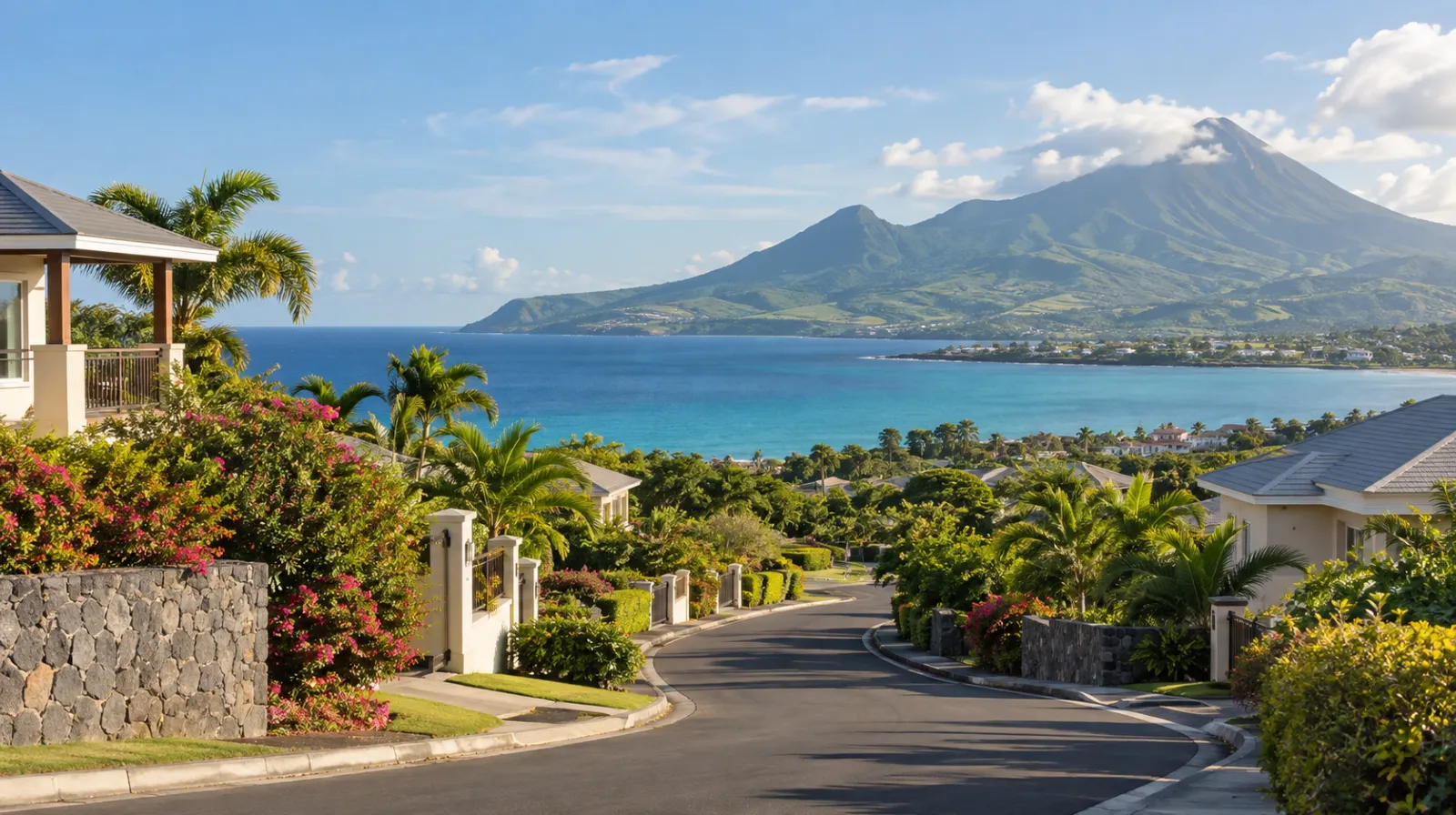
Living in St Kitts and Nevis offers a very different experience from relocating to a major international city. The twin-island federation combines small communities, tropical surroundings, English-speaking daily life and relatively short travel distances with the practical realities of island living, including a smaller healthcare system, limited public transport and a housing market that varies significantly between local neighbourhoods and resort-oriented areas. Anyone moving to St Kitts and Nevis should therefore evaluate daily costs, schools, healthcare, transport, housing and immigration status separately from any citizenship decision.
St Kitts and Nevis consists of two islands with distinct personalities. St Kitts contains Basseterre, the main commercial and administrative centre, while Nevis is smaller and generally more residential and low-density. Moving successfully requires choosing not only the right island, but also the right community and legal status for your family or work plans.
Key Takeaways
- English is the official language, which simplifies relocation for many international residents.
- The Eastern Caribbean dollar is fixed at EC$2.70 to US$1, reducing USD/XCD exchange-rate uncertainty.
- Housing costs vary sharply between local residential areas and premium coastal or resort communities.
- Healthcare is available on both islands, but serious cases may require overseas medical evacuation.
- Education is compulsory from ages 5 to 16, with public and private options available.
- The US travel advisory currently places the federation at Level 1: Exercise Normal Precautions.
- St Kitts and Nevis currently has no personal income tax, but residents may still face VAT, property tax and tax obligations elsewhere.
- Citizenship and physical relocation are separate decisions. Obtaining St Kitts and Nevis citizenship does not require permanent residence in the federation.
What Life in St Kitts and Nevis Is Like
The pace of everyday life is one of the biggest adjustments for newcomers. St Kitts has more commercial activity, government offices, shopping and employment around Basseterre and the surrounding areas. Nevis is smaller, quieter and more dispersed.
For many residents, daily life revolves around:
- Driving rather than relying on large public transport networks
- Shopping through a mix of supermarkets and local businesses
- Outdoor recreation and beaches
- Smaller professional and social networks
- Community events and local festivals
- Regular travel between St Kitts and Nevis
The country is part of the Eastern Caribbean, so climate and weather patterns also matter. Hurricane season should be considered when choosing a home, arranging insurance and preparing emergency supplies. The July 2026 travel advisory specifically highlights hurricane exposure even while maintaining the lowest general travel-advisory level.
St Kitts vs Nevis for Daily Living
| Factor | St Kitts | Nevis |
|---|---|---|
| Commercial activity | Higher | Lower |
| Main urban centre | Basseterre | Charlestown |
| Airport connectivity | Main international gateway | Regional airport and St Kitts connections |
| Lifestyle | More active | Quieter |
| Housing choice | Broad, including resort areas | Villas, local homes and low-density coastal options |
| Government services | More concentrated | Local NIA services |
| Best suited to | Workers, families needing easy services | Retirees, remote workers, quiet-lifestyle seekers |
Neither island is objectively better. Someone working in Basseterre may find St Kitts much more practical, while a retiree seeking privacy and a slower rhythm may prefer Nevis.
Cost of Living and Housing
The cost of living in St Kitts and Nevis depends heavily on lifestyle. Housing, imported goods, private schooling, vehicles, health insurance and frequent international travel can transform what initially looks like a relatively simple island budget.
Current crowdsourced cost databases should be treated cautiously because sample sizes for a country this small are limited. One 2026 dataset estimates monthly expenses of roughly EC$3,335 for one person and EC$8,659 for a family of four, but explicitly warns that the estimates are based on relatively few observations.
This makes a personalised relocation budget more useful than relying on a single published “average”.
Typical Monthly Budget Categories
Before moving, estimate:
| Cost Category | What to Check |
|---|---|
| Rent or mortgage | Local neighbourhood vs resort/coastal property |
| Electricity | Air-conditioning can materially change consumption |
| Water | Property-specific supply and storage arrangements |
| Groceries | Local products vs imported brands |
| Transport | Car purchase, fuel, insurance and licence costs |
| Healthcare | Local cover plus medical evacuation protection |
| Education | Public, private or international-style options |
| Internet/mobile | Coverage and speed at exact property |
| Household help | Availability and employment rules |
| Travel | Flights, ferries and overseas medical/business trips |
Renting a Home
Rental markets are small enough that individual property availability can distort averages.
Current international cost datasets suggest that a one-bedroom apartment may be significantly cheaper outside central or premium locations than in higher-demand areas, while three-bedroom homes show an extremely wide pricing range. The data is sparse enough that live local listings should always replace national averages before signing a lease.
For newcomers, renting for the first six to twelve months can be useful because it allows time to understand:
- Commuting patterns
- Water and electricity reliability
- Internet quality
- Neighbourhood noise
- School journeys
- Hurricane exposure
- Maintenance standards
A property that looks ideal during a short visit may feel different after several months of daily use.
Buying Property as a Foreigner
Foreign nationals can own property, but land ownership rules need to be checked before purchase.
The federation operates an Alien Land Holding licensing framework for non-nationals. Importantly, official Nevis guidance also states that owning property does not itself grant permanent residence.
This distinction is essential:
Buying a home ≠ obtaining permanent immigration status.
If property is being purchased as part of an approved CBI route, different programme-specific regulations can apply.
Property Tax and Ongoing Ownership Costs
Property owners should budget for more than the purchase price.
Property tax exists and is payable annually, with rates depending on property use and whether the property is situated on St Kitts or Nevis.
Potential ongoing costs include:
- Property tax
- Insurance
- Repairs
- Garden and pool maintenance
- Hurricane preparation
- Security
- Utilities
- Property management when abroad
A low purchase price does not necessarily mean low annual ownership costs.
Healthcare and Education
Healthcare and schooling are among the most important considerations for families moving to St Kitts and Nevis.
Healthcare
The principal public hospitals are Joseph N. France General Hospital on St Kitts and Alexandra Hospital on Nevis. Local facilities can manage many routine and emergency needs, but government guidance warns that serious medical cases may require evacuation, commonly to the United States or another overseas medical centre.
The government has also been investing in healthcare capacity. Recent initiatives include expanded diagnostic services, a government CT scanner and work towards new hospital infrastructure. A national digital health information system was also deployed at JNF General Hospital in August 2026.
What New Residents Should Do for Healthcare
Before relocating:
- Confirm whether your insurance is accepted locally.
- Add medical evacuation or repatriation cover where appropriate.
- Identify the nearest hospital or clinic.
- Confirm availability of any regular prescription medicine.
- Bring medical documentation for chronic conditions.
- Budget for treatment abroad if specialist care is needed.
Families with significant medical needs should assess specialist access before committing to full-time island residence.
Education
Education is universal and compulsory between ages 5 and 16. The system includes pre-schools, primary schools, secondary schools and technical or tertiary pathways.
Secondary education generally follows the Caribbean Examinations Council framework, including CSEC qualifications.
Families can consider:
- Government schools
- Private schools
- Early-childhood centres
- Technical and vocational education
- Overseas schooling for later stages
The Ministry of Education maintains a directory covering schools and education services on both St Kitts and Nevis.
Parents should investigate actual school placement before choosing a home because secondary-school allocation can depend on the child’s place of residence.
Safety, Transport and Daily Life
Safety
Current official US travel guidance rates St Kitts and Nevis at Level 1 – Exercise Normal Precautions, the lowest advisory category, as of 7 July 2026.
That does not mean residents should ignore normal precautions.
Practical measures include:
- Locking homes and vehicles
- Avoiding leaving valuables visible
- Confirming security arrangements before renting
- Using reliable taxis at night
- Following official hurricane and weather guidance
Safety decisions should be based on the exact neighbourhood and current local advice rather than broad country-level claims.
Driving and Transport
Cars are the most practical transport option for many long-term residents.
On Nevis:
- Vehicles drive on the left.
- Visitors or newcomers may need a temporary local driving licence.
- Taxis are widely available.
- Car rental provides greater independence.
Public minibuses and taxis operate locally, but residents accustomed to metro or rail systems should expect a more car-dependent lifestyle.
Travelling Between the Islands
St Kitts and Nevis are separate islands, so inter-island transport is part of everyday planning for some residents.
Passenger ferries between Basseterre and Charlestown generally take around 25–45 minutes, while car ferries connect Major’s Bay on St Kitts with Nevis.
This means living on Nevis while regularly conducting business on St Kitts is possible, but the ferry journey becomes part of the routine.
International Access
Robert L. Bradshaw International Airport on St Kitts is the federation’s primary international gateway.
Nevis also has Vance W. Amory International Airport, with regional connectivity, while many travellers reach Nevis through St Kitts followed by road and water transfer.
Frequent travellers should compare flight schedules and connection times before selecting which island to call home.
Taxes and Banking Basics
Tax information is especially important because St Kitts and Nevis is sometimes described too casually as “tax-free”.
That wording is misleading.
Personal Income Tax
Government business guidance currently states that there is no personal income tax in St Kitts and Nevis.
However, residents and investors may still encounter:
- VAT
- Property tax
- Corporate income tax
- Customs duties
- Business licence charges
- Social-security obligations
- Taxes in another country
Current 2026 consumer guidance confirms that the standard VAT rate is 17%, subject to specific rates and occasional government relief measures.
Therefore:
No personal income tax does not mean no tax.
Tax residency should also be considered separately from citizenship. A person can become a St Kitts and Nevis citizen without automatically becoming tax resident simply because of the passport.
International residents should obtain tax advice based on their nationality, residence, income and business structures.
Currency
The local currency is the Eastern Caribbean dollar, which has maintained a fixed rate of EC$2.70 to US$1 under the Eastern Caribbean Currency Union.
This makes USD budgeting relatively straightforward compared with currencies that float freely against the dollar.
Banking
Commercial banks operate under the Eastern Caribbean financial framework, and ATMs accept major international card networks.
New residents opening accounts should prepare for normal Know Your Customer and source-of-funds procedures.
Documents may include:
- Passport
- Proof of address
- Immigration status
- Tax identification information
- Employment or business evidence
- Source-of-funds documentation
International investors should never assume citizenship automatically guarantees bank-account approval.
Best Areas to Live
The best location depends on whether you prioritise work, schools, beach access, privacy or premium housing.
Basseterre
Basseterre is the practical choice for people who want immediate access to:
- Government offices
- Employment
- Banks
- Shops
- Healthcare
- Schools
- Ferry links
It suits professionals and families who prefer convenience over a resort-style environment.
Frigate Bay
Frigate Bay is often considered by international residents because it combines residential housing, beach access, restaurants and proximity to Basseterre.
It can work well for:
- Professionals
- Couples
- Families
- Residents wanting coastal living without being too remote
Housing costs may be higher than in more locally oriented communities, so live listings should be compared carefully.
Southeast Peninsula and Premium St Kitts Communities
The Southeast Peninsula contains lower-density coastal developments and premium residential environments.
These locations suit buyers prioritising:
- Privacy
- Views
- Newer luxury property
- Resort-style amenities
The trade-off is distance from Basseterre and greater dependence on a private vehicle.
Charlestown
Charlestown is Nevis’s main town and is the most practical Nevis base for residents who want access to shops, government services and ferry connections.
It provides a more local, small-town environment than premium beachfront zones.
Pinney’s Beach and Western Nevis
The western coast around Pinney’s Beach combines beaches, villas and established hospitality infrastructure. Official tourism information highlights private residences and beachfront villa accommodation around this part of Nevis.
It suits:
- Retirees
- Remote workers
- Second-home owners
- Residents seeking quieter coastal living
Premium housing can make this one of the more expensive residential options.
Moving Checklist for Individuals and Families
Relocation should be treated as a project rather than a single immigration application.
Before Moving
- Choose your legal status.
Determine whether you need a work permit, residence status, family permission or citizenship. - Visit before committing.
Ideally experience both St Kitts and Nevis. - Rent before buying.
Learn neighbourhood patterns before making a permanent property decision. - Create a realistic monthly budget.
Include insurance, travel, schooling and vehicle costs. - Arrange healthcare cover.
Confirm medical evacuation protection. - Research schools.
Check placement, curriculum and admissions before selecting a home. - Confirm work rights.
Residence and property ownership do not automatically grant unrestricted employment. - Prepare banking documents.
Source-of-funds and tax information may be required.
During the Move
Arrange:
- Passport and immigration documentation
- Birth and marriage certificates
- School records
- Medical records
- Insurance
- Temporary accommodation
- Local phone/internet
- Transport
- Banking
- Driving permission
During the First 90 Days
Focus on:
- Finalising long-term housing
- Understanding utilities
- Building a local healthcare network
- Confirming school routines
- Learning ferry and flight schedules
- Establishing emergency/hurricane planning
- Reviewing tax obligations
Families should avoid making several irreversible decisions—such as purchasing property and changing schools—during the first few weeks.
Citizenship and Long-Term Relocation
Citizenship and relocation should be considered separately.
Someone can move to the federation without obtaining investment citizenship, while someone can become a citizen through an approved programme without making St Kitts and Nevis their full-time home.
The current St Kitts and Nevis citizenship by investment programme offers four principal qualifying routes:
- Sustainable Island State Contribution from US$250,000
- Public Benefit Option from US$250,000
- Approved developer real estate from US$325,000
- Approved private real estate from US$325,000 for qualifying condominium interests or US$600,000 for qualifying private homes
Applications require government due diligence and are submitted through an authorised agent. Current programme guidance indicates a 120–180 day decision framework for the SISC route, subject to delays where additional review is required.
Does Citizenship Require You to Live There?
Currently, no mandatory residence period is required to maintain citizenship granted through the programme.
This is important because two applicants can use citizenship very differently.
One family may obtain citizenship and relocate permanently.
Another may:
- Continue living elsewhere
- Visit periodically
- Own property
- Retire there later
- Use citizenship as part of long-term family planning
The programme has also introduced biometric passport modernisation in 2026. New CBI applications submitted from 14 April 2026 include biometric enrolment, while existing programme citizens face a transition deadline in 2027.
For readers evaluating nationality rather than only lifestyle, the St Kitts and Nevis citizenship programme page should be reviewed separately from this relocation guide.
The key principle is simple:
A good citizenship option is not automatically the right place for you to live, and a good place to live does not automatically require citizenship.
Frequently Asked Questions
What is living in St Kitts and Nevis like?
Life is generally slower-paced and community-oriented, with English-speaking services, tropical surroundings and relatively short distances. St Kitts is more commercially active, while Nevis offers a quieter and lower-density environment.
Is St Kitts and Nevis expensive to live in?
Costs vary substantially by housing and lifestyle. Premium coastal homes, private education, imported goods and regular overseas travel can raise expenses significantly. Current national cost estimates are based on limited samples, so live local quotations are more reliable.
Is St Kitts and Nevis safe to live in?
Current US travel guidance rates the country Level 1 – Exercise Normal Precautions. Residents should still use standard security measures and prepare for tropical storms and hurricanes.
Is healthcare good in St Kitts and Nevis?
Public hospitals operate on both islands and provide many routine services, but serious cases may require medical evacuation overseas. International residents should consider comprehensive health and evacuation insurance.
Are there good schools in St Kitts and Nevis?
The country has public and private education, with compulsory schooling from ages 5 to 16 and a secondary system aligned with regional CXC qualifications. Parents should check individual schools and placement rules.
Is St Kitts or Nevis better for living?
St Kitts generally suits people prioritising employment, government services and urban convenience. Nevis may suit residents seeking a quieter environment, privacy and slower island living.
Can foreigners buy property in St Kitts and Nevis?
Yes, but non-national property ownership can involve Alien Land Holding rules and licensing. Property ownership itself does not automatically grant permanent residence.
Does St Kitts and Nevis have personal income tax?
Current government information states that there is no personal income tax. Other taxes, including VAT and property tax, still apply, and foreign residents may also have tax obligations elsewhere.
Do I need citizenship to move to St Kitts and Nevis?
No. Citizenship and immigration residence are separate legal concepts. The appropriate route depends on whether you plan to work, study, invest, retire or live there with family.
Do St Kitts and Nevis CBI citizens have to live there?
Current programme rules do not impose a mandatory residence requirement to maintain citizenship granted through the Citizenship Programme.