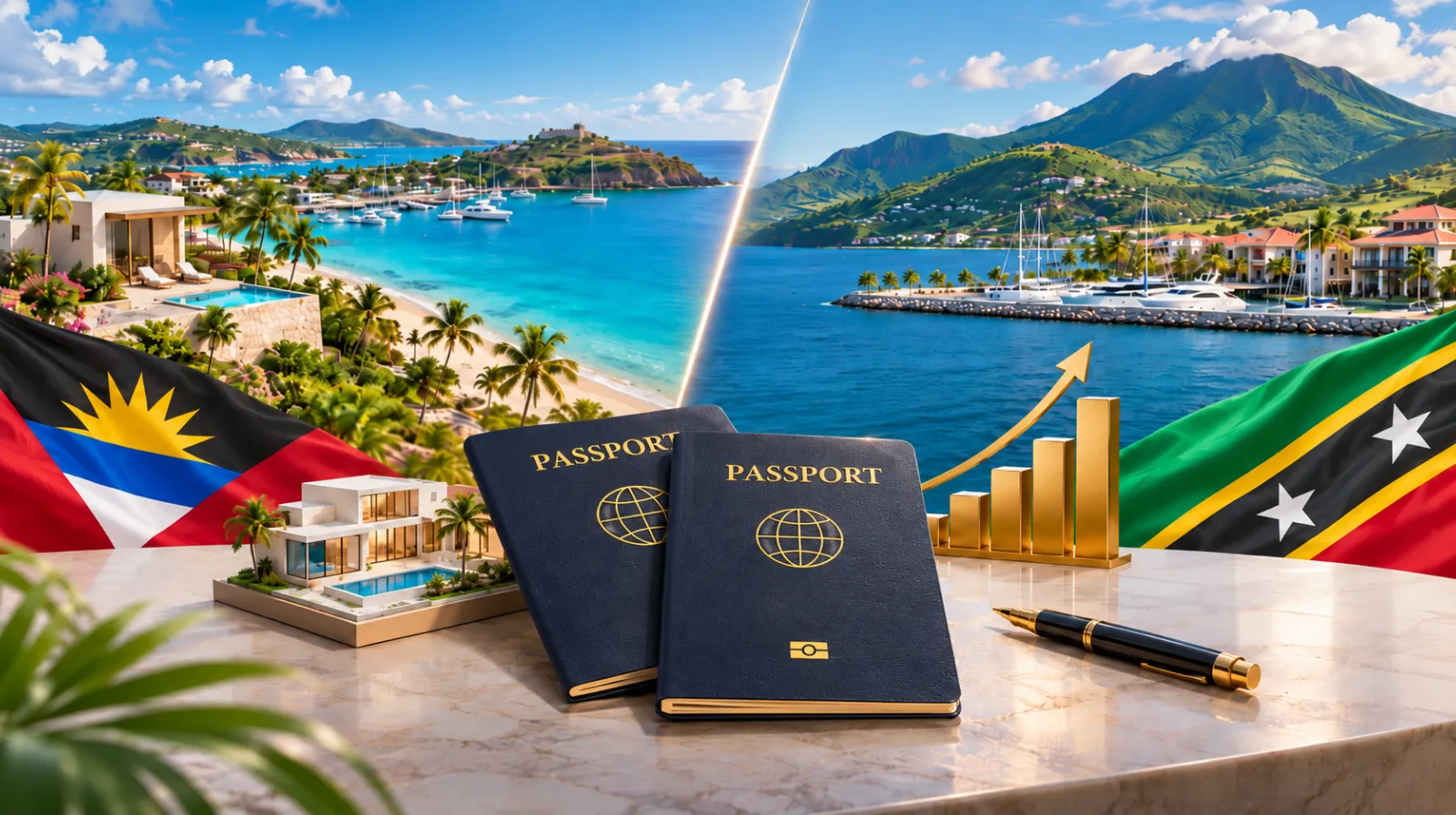
Choosing between Antigua vs St Kitts citizenship in November 2026 involves more than comparing their contribution thresholds. Antigua and Barbuda starts at US$230,000 through its National Development Fund, compared with US$250,000 for St Kitts and Nevis through the Sustainable Island State Contribution. Antigua can be particularly economical for large families, while St Kitts offers a longer programme history and no current mandatory visit requirement. However, both governments have announced plans to transition or wind down their citizenship-by-investment programmes following discussions with the European Union. Both are still accepting applications as of 21 November 2026, but future cut-off dates remain uncertain. Which option makes sense now depends on family eligibility, total costs, travel needs and your tolerance for regulatory change.
Last updated: 21 November 2026. All figures are in US dollars. Visa access, fee schedules, application procedures and programme operating status should be reconfirmed before submission. This guide provides general information, not immigration, investment or tax advice.
Antigua vs St Kitts Citizenship at a Glance
| Comparison | Antigua and Barbuda | St Kitts and Nevis |
|---|---|---|
| Minimum contribution | $230,000 NDF | $250,000 SISC |
| Family of four contribution | $230,000 | $250,000 |
| Real estate threshold | $300,000 | $325,000 approved unit; $600,000 private home |
| Other routes | UWI Fund, business investment | Public Benefit Option, developer/private real estate |
| Main applicant due diligence | $8,500 | $10,000 |
| Spouse due diligence | $5,000 | $7,500 if aged 16+ |
| Children below 12 | No due-diligence fee | No due-diligence fee if below 16 |
| Mandatory visit | Five days within first five years | None under current published rules |
| Property holding period | Five years | Seven years |
| Processing | Case-dependent; no guaranteed fixed deadline | Decision normally 120–180 days after acknowledgement |
| Programme position, November 2026 | Open; government requested wind-down transition to end-2030 | Open; orderly transition announced, closing date not set |
Minimum Investment and All-In Cost
Antigua’s Current Government Charges
The National Development Fund (NDF) contribution is $230,000, whether for one applicant or a family. Processing is $10,000 for a single person, $20,000 for up to four people, then another $10,000 per additional person from the fifth. Due diligence costs $8,500 for the main applicant, $5,000 for a spouse, $2,000 for each dependant aged 12–17 and $4,000 for each eligible adult dependant. Children below 12 do not incur the listed individual due-diligence charge. Passport issuance is $300 per person.
St Kitts’ Current Government Charges
The Sustainable Island State Contribution (SISC) requires $250,000 for the main applicant or a family of up to four. Additional dependants cost $25,000 each if under 18 or $50,000 each if 18 or older. Due diligence is $10,000 for the principal and $7,500 for each dependant aged 16 or above.
St Kitts also introduced mandatory biometric enrolment and upgraded passports in April 2026. Its published standard biometric/passport charges are $2,500 for the first adult, $2,000 for a second adult and $1,300 for each child under 16. A 10% reduction applies to qualifying bookings made and completed by 31 December 2026; the calculations below conservatively use the standard figures.
Worked Cost Examples
For an illustrative family of four, assume two married adults and two children aged under 12. For the family of six, assume the same adults and four children under 12.
| Family profile | Antigua: NDF minimum subtotal | St Kitts: SISC minimum subtotal |
|---|---|---|
| Single applicant | $248,800 | $262,500 |
| Couple + 2 children under 12 | $264,700 | $274,600 |
| Couple + 4 children under 12 | $285,300 NDF; $275,300 UWI | $324,700 |
These are published-fee planning subtotals, not final all-in quotations. Antigua figures include the contribution, standard processing, applicable due diligence and $300 passport fee per person. St Kitts figures include SISC, applicable due diligence and standard biometric/passport charges; separate processing, certificates, professional expenses and other costs may still apply. Both countries can charge additional costs for complex cases, document certification and transfers.
For the family of six, Antigua’s UWI Fund makes a meaningful difference: the $260,000 contribution includes processing for the first six applicants, before due diligence and passports.
Compare Your Citizenship Investment Costs
Choosing between Antigua and Barbuda and St Kitts and Nevis? The total investment depends on your family size, dependant eligibility, government fees and preferred investment route.
Contact Caribbean Paradise for a personalised cost comparison and explore which citizenship programme best matches your financial goals and family requirements.
Donation, Real Estate and Alternative Routes
Contribution Routes: NDF vs SISC
Both programmes have a non-refundable government contribution pathway. Antigua’s NDF starts lower, at $230,000, while St Kitts’ SISC begins at $250,000. Neither payment creates a property interest or financial asset that can later be sold.
Antigua normally collects due diligence and 10% of processing charges on application. The remaining processing amount, passport fees and contribution are payable after approval under official instructions. St Kitts likewise requires assessment before the qualifying contribution is completed.
Property: Five Years vs Seven
Antigua’s approved real-estate option starts at $300,000, with the property generally held for at least five years. St Kitts’ approved developer route begins at $325,000; designated private condominium interests also start at $325,000, while a qualifying single-family private home requires at least $600,000. Its standard holding period is seven years.
Approved projects may carry conveyancing, insurance, maintenance or resale restrictions. A property must be programme-approved; buying an ordinary house does not automatically qualify. Assess ownership rights, liquidity, management charges and the developer’s record before committing capital.
Alternative Investment Structures
Antigua’s University of the West Indies Fund is available to families of six or more at $260,000, including processing for the first six. It also offers a one-year tuition-only university scholarship for one qualifying family member. Antigua additionally permits approved business investment, starting at $1.5 million for a sole investor or $400,000 per investor in a qualifying joint investment of at least $5 million.
St Kitts offers a Public Benefit Option starting at $250,000, alongside SISC and the two real-estate structures. Additional post-approval government fees apply to the Public Benefit and property routes; therefore the minimum investment figure should not be treated as a complete application cost.
Family and Dependant Eligibility
Family definitions may determine eligibility before cost becomes relevant. Both programmes accept a spouse and qualifying children and older parents, but Antigua permits some relatives who are not standard eligible dependants under St Kitts’ current published rules. In practice, a family member who does not meet the published dependency definition cannot simply be added by paying an extra fee.
Antigua’s Broader Family Categories
Antigua can include financially dependent children up to age 30, certain adult children with disabilities, dependent parents and grandparents aged 55 or above, and qualifying unmarried siblings. It also provides routes to add certain family members after citizenship, subject to separate conditions and fees.
St Kitts’ Family Categories
St Kitts normally accepts a spouse; children under 18; children aged 18–30 who are studying full-time and fully supported; adult children with qualifying disabilities; and dependent parents aged 55 or above who live with and are fully supported by the main applicant. A standard sibling category should not be assumed.
St Kitts’ SISC can be cost-efficient for a family of up to four because the contribution does not rise within that group. However, a fifth or sixth person increases the contribution, while Antigua’s NDF keeps its base contribution unchanged and increases processing fees instead.
Why Ages Matter
A 10-year-old and a 20-year-old can change the comparison materially. Antigua’s due diligence applies from age 12 and uses different amounts for teenagers and adults. St Kitts generally charges $7,500 per dependant aged 16 or over. Before choosing a country, build a family schedule covering relationship, age, education, dependency, document availability and future additions.
Processing Time and Due Diligence
Both countries require an authorised application channel, checks on identity and criminal background, and evidence of lawful wealth.
St Kitts’ Published Decision Window
St Kitts says the Citizenship Unit normally advises whether an acknowledged application is approved in principle, denied or delayed for cause within 120–180 days. This is a decision window, not an unconditional passport-delivery promise. The main applicant must attend an interview; dependants aged 16 or above may also be interviewed under the route guidance. All new applications submitted from 14 April 2026 require biometric enrolment once the appropriate approval stage is reached.
Antigua’s Case-Dependent Process
Antigua’s current application guidance says its Unit may request additional information and an interview. An authorised representative works with a licensed local agent to file the forms and supporting evidence. There is no reliable basis for guaranteeing every application will finish within a fixed number of weeks. Family complexity, verification and any new transition deadlines should be considered before booking travel or making time-sensitive business plans.
Important: Some St Kitts materials describe interviews for dependants aged 16+ as discretionary, while newer programme documentation presents broader interview requirements. Applicants should follow the instruction issued for their particular case rather than assume a dependant will be exempt.
Residency and Visit Requirements
This comparison produces one of the clearest practical differences between the programmes.
Antigua’s Five-Day Rule
Antigua requires an investment citizen to spend a total of at least five days in Antigua and Barbuda within the first five calendar years after receiving citizenship. The published rules warn that failure to satisfy this requirement can result in deprivation of citizenship. Initial passport renewal is also linked to meeting the five-day requirement.
Five days is a limited commitment, not an obligation to relocate permanently. Still, applicants should budget for a real visit and keep evidence of entry, departure and time spent. For a family applying together, do not assume the main applicant’s visit automatically fulfils every relative’s obligations without confirming their individual requirements.
St Kitts’ Current No-Visit Position
The St Kitts SISC information currently states no mandatory travel or residence requirement to obtain or maintain citizenship.
However, the future framework is in transition. A November 2026 comparison should distinguish today’s published absence of a visit requirement from possible future changes to programme admission or genuine-link obligations. Neither government has provided a basis for promising that all current conditions will remain unchanged indefinitely.
Visa-Free Travel and Passport Mobility
A comparison of Antigua vs St Kitts passport strength should use the same index and update date. The current Henley Passport Index lists St Kitts and Nevis at 156 destinations accessible without a prior visa, versus 153 for Antigua and Barbuda. The scores reflect the index methodology rather than a promise of entry to every destination.
This is a small quantitative advantage for St Kitts, not proof that it is better for every traveller. A passport’s practical value depends on which destinations an applicant actually visits, the permitted duration and whether business, work or residence rights are needed. Visa-free tourism does not automatically authorise employment.
Both passports have historically offered useful international access, including Schengen short stays under applicable rules. But the 2026 European Union discussions mean future visa-free access should not be promised. The governments’ transition announcements seek to protect international relationships; they do not guarantee that entry rules will remain unchanged for the lifetime of a passport. Verify critical destinations shortly before travel.
Passport Renewal and Ongoing Obligations
Antigua: Five-Year Initial Passport
The current Antigua CIU page states that a passport issued through the investment programme is initially valid for five years. Renewal is connected to the citizen having spent the required total of five days in Antigua and Barbuda during that period.
St Kitts: Mandatory Biometric Upgrade
In April 2026, St Kitts introduced biometric enrolment for its citizenship-programme population. Existing CBI passports issued before 14 April 2026 stop being accepted for international travel after 31 July 2027 unless the holder completes the required enrolment and obtains an appropriate upgraded document. Existing citizenship is not cancelled by the passport modernisation.
The scheme covers adults and dependants, including children, through age-appropriate enrolment. The two programmes therefore impose different forms of ongoing administration: Antigua requires a short visit; St Kitts currently requires biometric compliance and upgraded passports.
Program History and Stability
St Kitts began its citizenship-by-investment programme in 1984; Antigua launched its programme in 2013. St Kitts consequently has a longer record of programme administration, policy changes and investor experience.
Major November 2026 Developments
On 12 November 2026, Antigua’s Citizenship by Investment Unit confirmed that it remained operational and continued accepting applications. Its memorandum disclosed that the government had told the European Commission on 30 October that it intended to wind down the programme and had requested a transition extending to the end of 2030. That requested date was not presented as an agreed final deadline.
On 16 November 2026, St Kitts’ Citizenship Unit also confirmed an orderly transition following a government decision announced on 13 November. It said new applications would remain open until an official final receipt date is determined, existing files would continue to be processed, and thresholds or due-diligence standards would not be relaxed during transition.
These announcements materially affect both programmes. It would be inaccurate to call either closed today. It would be equally inaccurate to advertise either as indefinitely available.
What Does Stability Mean Now?
Investors should assess stability across several dimensions: enforceable citizenship status, transparent rules, screening integrity, passport services, diplomatic access and treatment of existing applicants during a transition.
Both governments have indicated that lawful existing citizens are not automatically stripped of nationality because of the intended transition. However, citizenship continuity and visa-free access are different questions. A passport may remain valid as a document while third-country travel policies change.
Which Program Fits Different Applicant Profiles?
Single Applicant Focused on Cost
Antigua is generally less expensive at the published contribution level and in the worked single-applicant subtotal. Someone focused on minimising sunk costs may prefer NDF, but should value the required five-day visit and the possibility of rule changes during the programme transition.
Family of Four
Antigua’s NDF is competitive for two adults and two young children. St Kitts narrows the gap through its flat family-of-four SISC contribution, but due diligence and biometric/passport charges still matter. If children are older, request a second illustration because the due-diligence age thresholds differ.
Large or Multigenerational Family
Antigua deserves priority consideration where six or more eligible relatives are applying. Its UWI Fund and comparatively flexible dependant categories can reduce the official cost substantially. Explore the detailed best Caribbean passport for families guide before finalising the family list.
Investor Who Cannot Travel
St Kitts is currently the easier practical fit because its published SISC rules do not impose Antigua’s five-day visit. A person who cannot attend biometric enrolment should not assume the route is entirely travel-free in practice.
Property Investor
Antigua begins at a lower real estate threshold and has a shorter minimum holding period. St Kitts offers approved developer investments and a private-home route with a seven-year hold. Compare transaction fees, ownership title, use rights, ongoing charges and the actual secondary market. A qualifying investment is not a guaranteed resale opportunity.
Applicant Most Concerned About Policy Risk
Neither programme can now be described as unaffected by announced wind-down planning. Ask the agent to identify the last officially confirmed application date, explain how files already lodged will be treated and document each payment milestone. Avoid rushed commitments based on an unverified claim that places are about to disappear.
The total cost of Antigua and Barbuda citizenship by investment and St Kitts and Nevis citizenship by investment depends on several factors, including family size, dependant eligibility, the selected investment route, government fees and due diligence requirements. Applicants should also consider Antigua’s physical-presence requirement, St Kitts and Nevis’ biometric passport procedures, and the latest programme regulations and transition timelines. Comparing these factors alongside the total investment provides a clearer understanding of which programme better suits individual and family circumstances.
Frequently Asked Questions
Is Antigua or St Kitts citizenship cheaper?
Antigua’s NDF starts at $230,000, compared with $250,000 under St Kitts’ SISC. In the single-applicant examples here, Antigua’s published-fee subtotal is $248,800 and St Kitts’ is $262,500, before other possible charges. Family composition can change the gap.
Which programme is better for a family of six?
Antigua is often more cost-effective because its UWI Fund covers the first six eligible applicants for $260,000 including processing, before due diligence and passport charges. St Kitts’ SISC adds contributions for fifth and sixth dependants. However, eligibility must be checked individually.
Do I have to visit Antigua and Barbuda?
Yes. Under its current rules, investment citizens must spend at least five days in the country during the first five calendar years. Failure can affect citizenship and passport renewal.
Is St Kitts still accepting CBI applications in November 2026?
Yes. The Citizenship Unit’s statement dated 16 November 2026 says the programme remains operational and will accept new applications until a final receipt date is officially announced. The government has nonetheless decided on an orderly transition.
Is Antigua ending its citizenship-by-investment programme?
Antigua has indicated an intention to wind down and requested a transition to the end of 2030, but its Citizenship by Investment Unit confirmed on 12 November 2026 that the programme remained open. The proposed end date had not been confirmed as a final agreed deadline.
Which passport offers more visa-free access?
The current Henley methodology shows a narrow advantage for St Kitts and Nevis: 156 destinations without a prior visa versus Antigua and Barbuda’s 153. Travel rights change and should be checked for each intended destination.
Does a programme wind-down cancel existing citizenship?
The current official transition statements do not announce automatic cancellation of lawfully acquired citizenship. Nevertheless, possession of citizenship does not guarantee that other countries will preserve the same visa-free access indefinitely.
How do I choose between the programmes now?
Compare your family’s actual eligibility, complete government and professional costs, physical-presence commitments, property preferences, passport compliance and the most recent official transition notices. Request a written current-fee and application-status assessment before paying non-refundable amounts.
Conclusion
There is no single winner in Antigua vs St Kitts citizenship. Antigua currently offers lower entry costs, broader family categories and an attractive six-person UWI route. St Kitts offers the longer programme history, a slightly stronger current passport-mobility score and no standard five-day visit requirement. The November 2026 transition announcements add an essential new consideration: both options remain open, but their future application windows are under discussion. Choose on the basis of verified eligibility, actual family cost and realistic long-term benefits—not headline contribution figures or promises of permanent visa-free travel.